February 17, 2018

tarang bulan


tarang bulan - /ta-ráng bu-lan/ Ta'u-sug snack; dw Bahasa Melayo tarang [bright] + Tausug bulan [moon]) [n.] bright moon pancake \stuffed folded golden pancake.


Other local name:

  • Muslim hotcake in Chavacano [Zamboangueño]


A traditional pancake made with a runny batter of flour mixed with some water (or fresh milk), baking powder, sugar, and yellow-orange food color.

A Tausug lass selling tarang bulan in Zamboanga City public market.

A pan is pre-heated and brushed with butter (or margarine) on the surface. A scoop of the batter is poured on the pan and set to cook on medium fire until the batter formed into a round patty of pancake with bubbly perforation on its surface and smooth on the underside. The pancake is removed from the pan and the top side is spread with sweetened boiled mongo beans (mung beans) then folded halfway making it look like a half-moon.

When serving, the tarang bulan is sliced into parts.

This snack originated in neighboring Asian countries and can be found also in Indonesia and Malaysia.

Tausug tarang bulan in the corner of Zamboanga City's public market (2013). 
.

The name tarang bulan is from the Bahasa Melayo tarang meaning "bright" and Tausug bulan meaning "moon." The shape and its bright yellow-orange color are enough explanations for why this folded stuffed pancake is aptly called the bright moon.


What makes tarang bulang different from the usual pancake we have in other regions is that it has a spread of sweetened boiled mongo beans inside the fold.


Personal notes:

If you need to look for this in Metro Manila, don't go far, you can find them on weekends in Maharlika Village near the Blue Mosque.

If you prepare the pancake of tarang bulan by yourself, you can follow the way western pancake or the Tagalog and Visayan hot cake is done. Just make it way a lot bigger and thicker than those you found in the morning menu of Jollibee and McDo. You sprinkle the batter with a little amount of ground salt to make the patty pancake more savory. Adding a dash of cinnamon powder or droplets of vanilla extract would make the pancake lusciously aromatic. Boiled pandan leaf extract will do it too.

For the sweetened mongo beans, you can prepare them like the way minatamis na monggo is done for the traditional summer halo-halo or of pan de mongo and hopia monggo. It's the same sweetened mongo you can find stuffed in ensaymadang monggo.

If you're fed up with mung beans all your life or afraid of having gout pains later in your joints, you can vary the fillings.  Instead of sweetened mung beans, use haleyang ube, strawberry jam (from Benguet), minatamis na buko or macapuno, peanut butter, cheese, omellete, chocolate spread, or leche flan.

For fresh milk, you can substitute it with milk powder mixed with water.  Try kakang gata, it will do wonder too.


Related posts:

All photos by Edgie Polistico in this blog are copyrighted. ALL RIGHTS RESERVED.


See Index of Entries here.


If you liked this post, share it.

Let us know your opinion on the subject. Feel free to comment in the comment section, below. It is important for us to know what you think.

Tell us what other topics you would like us to write, share, and discuss.

Continue to follow my blogs. You can also follow and learn more by joining us in our Facebook group account of Philippine Food Illustrated (Private) and Philippine Food Illustrated (Public). It is my pleasure to rediscover the known and least known things or the unheard ones and put them here for everyone to find, learn, and treasure. 

Thank you for all the encouragement and enthusiasm. I need also moral support, prayers, and anything else that can uplift my spirit and keep my good reasons. 

If you are pleased or happy with this blog, please share the PHILIPPINE FOOD ILLUSTRATED. It is energizing that my blog is shared with others. 

Edgie Polistico  


For more about Filipino food, see  this Philippine Food, Cooking, and Dining Dictionary. It is OPEN and FREE.

February 11, 2018

pebre

pebre - /peb-re/ Caviteño sauce/condiment; dw Chilean (Chile, South America) pebre [salsa of assortment of chopped spices, tomatoes, and pepper] = Catalan (Catalonia region, Spain) pebre [pepper]) [n.] lechon sauce \liver sauce for lechon baboy.

Similar local dishes:

  • lechon sauce or sarsa ng litson in Tagalog

  • lechon sauce in Cebuano, Ilonggo, Ilocano, Capampangan, and other Philippine languages and vernaculars


This lechon sauce of Cavite City is used to be for lechon baboy (roasted pig)  only, but later on served also as a dipping sauce for other roasted and fried dishes, such as litson manok (roasted chicken)fried pork chop, pritong isda, even for lumpia.

It has a paste of ground cooked liver of pig (or chicken), bread crumbs, water, brown sugar, onion, garlic, other spices, salt, and ground peppercorn. Named after the Chilean condiment of the same name but the foreign salsa is quite different being that it has no liver in the ingredients but an assortment of spices, ground or pureed spicy aji peppers, and chopped tomatoes, and may vary in different regions of Chile. 

The word pebre in Catalan (Catalonia in northeastern Spain and partly southern France) refers to the pepper of any type. 

The Caviteño pebre is a combination of sweetness and sourness and the peppery piquancy of ground peppercorn. This is the origin of your fave Mang Tomas sauce, a popular commercial liver sauce for your lechon baboy and litson manok.


All photos by Edgie Polistico in this blog are copyrighted. ALL RIGHTS RESERVED.


See Index of Entries here.


If you liked this post, share it.

Let us know your opinion on the subject. Feel free to comment in the comment section, below. It is important for us to know what you think.

Tell us what other topics you would like us to write, share, and discuss.

Continue to follow my blogs. You can also follow and learn more by joining us in our Facebook group. Have more bits and pieces about our kind of food, ingredients, and ways of cooking, dining, and knowing food culture across the 7,641 islands of the Philippines. I will search for more and continue to share my findings. It is my pleasure to rediscover the known and least known things or the unheard ones and put them here for everyone to find, learn, and treasure. 

Thank you for all the encouragement and enthusiasm. I need your moral support, prayers, and anything else that can uplift my spirit and keep my good reasons. Keep them coming. 

Sharing is happiness to me.  If you are pleased and happy with what you found here, please share the happiness we have in the PHILIPPINE FOOD ILLUSTRATED. I feel energized when it becomes part of the reasons why you are happy and smiling. 


For more about Filipino food, see  this Philippine Food, Cooking, and Dining Dictionary. It is OPEN and FREE.


November 26, 2017

buy-o

Photo credit to Jose Benigno Salvador


buy-o - /búy-oSambali [Botolan, Zambales] condiment\seasoning) [n.] Botolan salt in woven nipa palm pouch.

Other local name:
  • asin sa buy-o in Tagalog

Buy-o is originally the Sambali name for that cylindrical pouch that is made of woven nipa palm. This container is used to pack the raw sea salt produced in Botolan, Zambales. Thus, in Tagalog, the salt is called asin sa buy-o (salt in buy-o). The nipa palm (leaves) are cut off from the frond and the blades of the palm are sewn together in a pattern of overlapping each other side by side until they become a wide sheet. The sheet of sewn palms is rolled to shape and look like a cylindrical fat bottle. The circular frame or ring at the base is made of a palm frond. The strips used in stitching the palms could be thin strips of bamboo, rattan bark, or the bark of nipa frond. 

The tip of the container is tapered to look like the mouth of PET bottles, folded and secured tightly with a strip. When the salt is needed, the topmost part of the pouch is cut off or loosened so as to open the container and allow access to the salt inside. 


The floor at the base is made of latticed palm midribs or straw lined with a sheet of food-grade sack that allows the salt to breathe inside. 

A handle is attached on the side that is made of a bent bamboo stick or hemp rope that loops upward. 

The salt is produced by collecting sands that have been soaked for so long in the sea or seashore of Botolan. Sands on the seashore of Botolan that are always soaked in seawater on high tide are heavily saturated with salt deposits. The sands are collected when the sea is ebbing down to its lowest level. It is best to scoop sands at this moment as it would be a lot easier when they are not underwater. The sands can also be made saturated with salt by getting water from the Botolan sea and pouring it on a bed or mound of collected sand on the dry shore and then allowing the sand to dry under the sun. The pouring of seawater and sun drying is done over and over again the whole day at regular intervals until the sand is heavily saturated with salt. In between pouring and sun drying, the sand is turned over with a rake to evenly distribute the saturation of salt.

The collected sands are hauled into a large wooden funnel-shaped strainer and poured with the final round of seawater. The saline water that comes out down through the strainer is collected and boiled continuously in a boiler (usually a kawa, big wide round cast-iron pan) until white crystals of salt are produced at the bottom of the boiler. When the boiler is about to get dry, more water from the strainer is added to the boiler so as to keep producing salt. The white crystals of sea salt produced are collected using a woven bamboo splits scooping basket that allows the salt to drip and dry. When dry, the salt is then packed in buy-o for keeping.

The buy-o salt is densely packed inside the palm pouch that after some time, it would harden and has to be scraped off when needed in cooking or for other uses. 

Asin sa buy-o is the Tagalog name for this Botolan artisanal salt, and it means "salt in nipa palm pouch."


See Index of Entries here.


If you liked this post, share it.

Let us know your opinion on the subject. Feel free to comment in the comment section, below. It is important for us to know what you think.

Tell us what other topics you would like us to write, share, and discuss.


Related topic:

For more about Filipino food, see  this Philippine Food, Cooking, and Dining Dictionary. It is OPEN and FREE.


You can also follow and learn more by joining us in our Facebook group

Thank you for all the encouragement and enthusiasm. I need your moral support, prayers, and anything else that can uplift my spirit and keep my good reasons. Keep them coming. 

Sharing is happiness to me.  If you are pleased and happy with what you found here, please share the happiness we have in the PHILIPPINE FOOD ILLUSTRATED. I feel energized when it becomes part of the reasons why you are happy and smiling. 

Click here on how else you can help me. Thank you for your kindness and support. 

Edgie Polistico 


November 25, 2017

sadya


sadya /sad-yâ/ Caviteño [Tanza, Cavite] bread; dw Tag. sadya [special]) [n.] specially baked bread roll of Tanza, Cavite.


Loaves of sadya at PHP65.00 a piece (2017).
 
A big-size version of Philippine monay bread made special by the Kaibigan Bakery of Brgy. Biwas, Tanza, Cavite. 

You have to come early because this bread is fast selling in the morning. By past noon, all are gone - sold out.
Sadya is a Tagalog word, which means intent or purpose. For this bread, sadya is a descriptive name to mean "specially made" with a purpose or intent to satisfy the customer (or anybody else who will take this bread). It is called sadya because the baker has to make this bread a pinasasadya or what we fondly called now as "special.It is done by using specific ingredients and by following specific baking procedures. 

Suggested serving is to split the loaves into halves then slice the half into slabs.

Sadya of Tanza is made special by Kaibigan Bakery with special ingredients and flavors added to the dough. It has plenty of itlog na pula (salted eggs) that are fresh and uncooked (not boiled) and premium butter. Kaibigan Bakery now preferably used Magnolia Gold Pure & Creamy Butter. In the past, an unrecalled brand of premium butter was used.

Suggested serving is to slice the halves into slabs, to make it easy to spread with jam, peanut butter, mayonnaise, or pesto. You may also sandwich or top the sliced bread with fried egg, bacon, greens, or whatever you like.

Sadya is one of the old-time Caviteño favorites that you can buy best from Kaibigan Bakery, a Caviteño panaderia established in 1920.

A loaf is sold at PHP65.00 a piece in the bakery as of 2017. Priced more if you buy it from the resellers in Tanza public market. But you have to come early because this bread is fast selling in the morning. Past noon, all are gone - sold out. Over the years, the Kaibigan Bakery had not opened any branches. It would just distribute its freshly baked bread to a number of resellers in the public market of Tanza, Cavite.


My first visit at Kaibigan Bakery on its original spot along Hugo C. Arce Street in Brgy. Biwas, Tanza, Cavite.

My special thanks to a good friend, Ige Ramos for bringing this up first in his Facebook posts. It was like a whiff and I followed the smoke that eventually led me to where the Kaibigan Bakery when I happened to be in the coastal side of Cavite province. He was right of describing it as ang tinapay na amoy usok (smoky). It is the compliment of smoky flavor from firewood-fueled pugon, a traditional oven of bricks laid on thick bed insulation of sea salt.


See Index of Entries here.


If you liked this blog, please share.

Let us know your opinion on the subject. Feel free to comment in the comment section, below. It is important for us to know what you think.

Tell us what other topics you would like us to write, share, and discuss.

_______________________

All photos by Edgie Polistico are copyrighted. ALL RIGHTS RESERVED.


For more about Filipino food, see  this Philippine Food, Cooking, and Dining Dictionary. It is OPEN and FREE.


Continue to follow my blogs. You can also follow and learn more by joining us in our Facebook group account of Philippine Food Illustrated (Private) and Philippine Food Illustrated (Public)  It is my pleasure to rediscover the known and least known things or the unheard ones and put them here for everyone to find, learn, and treasure. 

Thank you for all the encouragement and enthusiasm. I need also moral support, prayers, and anything else that can uplift my spirit and keep my good reasons. 

If you are pleased and happy with this blog, please share the PHILIPPINE FOOD ILLUSTRATED. It is energizing that my blog becomes one of the reasons why someone is happy and smiling. 

Edgie Polistico  

November 15, 2017

saklob

saklob - /sak-lób/ Caviteño [Tanza, Cavite] bread; dw Tag. saklob [face-to-face]) [n.] A pair of two sweet bread, paired face-to-face.


  • buddy-buddybody-bodyor double body in Cebuano, Boholano, and Ilonggo


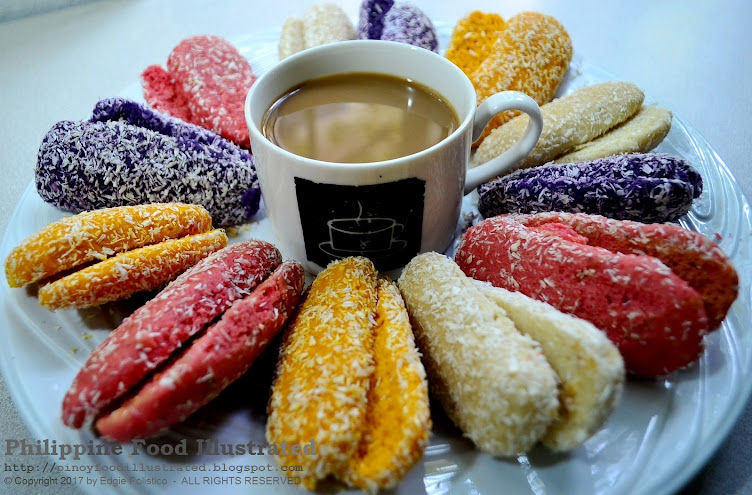
A pair of sweet bread, shaped like a thick tongue, and rolled in desiccated shreds of coconut meat. 

Saklob is an old Tagalog word for "face-to-face."

Saklob bread in four colors, a product of  Kaibigan Bakery. To get your freshly baked saklob, you may visit the  bakery at Hugo C. Arce Street of Brgy. Biwas in Tanza, Cavite.

Saklob bread is dense in every bite but somewhat soft and a bit cakey. 

It is quite sweet, and with a texture  somewhat like a dense cake.

A perfect terno (pair) for hot coffee. Also a good partner for a cold softdrink (cola or soda).

The loaves would spoil in two days because of the shredded coconut meat used as a coating of the bread.

In Visayas, there is a similar pastry they called buddy-buddy or double body with pieces shaped into a rounded or oblong flatbread. Noticeably, the Visayan version is crisp like a cookie.

These packs (above) and mounds (below) of freshly baked saklobs  are readied by Kaibigan Bakery for distribution to resellers in Pamilihang Bayan Ng Tanza, where a pack  of 6 saklobs is sold at PHP5.00 as of 2017.


All photos by Edgie Polistico are copyrighted. ALL RIGHTS RESERVED.


See Index of Entries here


If you liked this post, share it.

Let us know your opinion on the subject. Feel free to comment in the comment section, below. It is important for us to know what you think.

Tell us what other topics you would like us to write, share, and discuss.


For more about Filipino food, see  this Philippine Food, Cooking, and Dining Dictionary. It is OPEN and FREE.


Continue to follow my blogs. You may also follow and learn more by joining us in our Facebook group. Have more bits and pieces about our kind of food, ingredients, and ways of cooking, dining, and knowing food culture across the 7,641 islands of the Philippines.

Thank you for all the encouragement.  They fueled my enthusiasm. Continue to give your moral support, prayers, and whatever else that can uplift my spirit and keep my good reasons.

Share PHILIPPINE FOOD ILLUSTRATED with others.


Edgie Polistico  


November 2, 2017

samak


samak /sa-makIlocano tree /bark /leaf /fermentation agent) [n.] parasol leaf tree (sc.name: Macaranga tanarius, Linn.) \elephant’s ear

 binunga in Tagalog and Ilonggo

 minunga in Bicolano 


A small tree with medicinal bark, leaves, and fruits is used in fermenting and coloring basi (sugarcane wine), sukang Iloko (Ilocano sugarcane vinegar), and tuba (palm wine) in some places of Luzon.


How to tell binunga leaves from binungang-malapad. 

Binunga leaf  (Macaranga tanarius) is very much like that of Macaranga grandifolia (of botanists Fr. Francisco Manuel Blanco and Elmer Drew Merrill) commonly known as binungang-malapad in Tagalog. They are often confused and mistaken to be the same.  The slight variation is the "rounded" shape of tanarius compared to grandifolia's "heart shape" with more pointed and sometimes curvy bottom tip.


All photos by Edgie Polistico are copyrighted. ALL RIGHTS RESERVED.


See Index of Entries here


If you liked this post, share it.

Let us know your opinion on the subject. Feel free to comment in the comment section, below. It is important for us to know what you think.

Tell us what other topics you would like us to write, share, and discuss.


For more about Filipino food, see  this Philippine Food, Cooking, and Dining Dictionary. It is OPEN and FREE.


Continue to follow my blogs. You can also follow and learn more by joining us in our Facebook group. Have more bits and pieces about our kind of food, ingredients, and ways of cooking, dining, and knowing food culture across the 7,641 islands of the Philippines. I will search for more and continue to share my findings. It is my pleasure to rediscover the known and least known things or the unheard ones and put them here for everyone to find, learn, and treasure. 

Encouragement and enthusiasm are not enough. I also need moral support, prayers, and anything else that can uplift my spirit and keep my good reasons. Keep them coming. All I know is that I am happy with what I am sharing and giving away. If you are pleased and happy with what I am doing, just smile and please share the happiness. Keep sharing and include to share the PHILIPPINE FOOD ILLUSTRATED. I feel energized when my blog becomes one of the reasons why you are happy and smiling. 

Edgie Polistico

HELP ME. I NEED YOUR SUPPORT TO KEEP THIS BLOG GOING


Your contribution will help fund Edgie Polistico's research and development of Pinoy dictionaries.

CLICK HERE on how else to help this project

Help Me

Help Me
This will help Edgie Polistico continue his research and post more in this blog. Your contribution will help fund Edgie Polistico's research and development of Pinoy dictionaries. More discoveries, information, and knowledge will be shared to you and to others because of your generosity. Thank you for giving.

EDGIE'S FORBIDDEN PAGES

USE THIS FREE food dictionary now:

MAIN PAGE

MY COOKING and RECIPES