July 15, 2018

linabog nga tilapia


linabog nga tilapia - /li-na-bóg nga ti-láp-ya/ Ilonggo, Cebuano, and Boholano dish) [n.] Tilapia fish in thick  and spicy hot coconut milk.

Fresh tilapias are gutted and scaled

Linabog is an old-time Visayan seafood delicacy.  Originally, it uses meat from cartilaginous fish, such as pagi (ray) or iho (shark). The meat of dugong (manatee), butanding (whale shark), and balyena (whale) are also favored when available. If not available, slimy freshwater fish is used, like the hito (catfish) or the haluan (mudfish). 
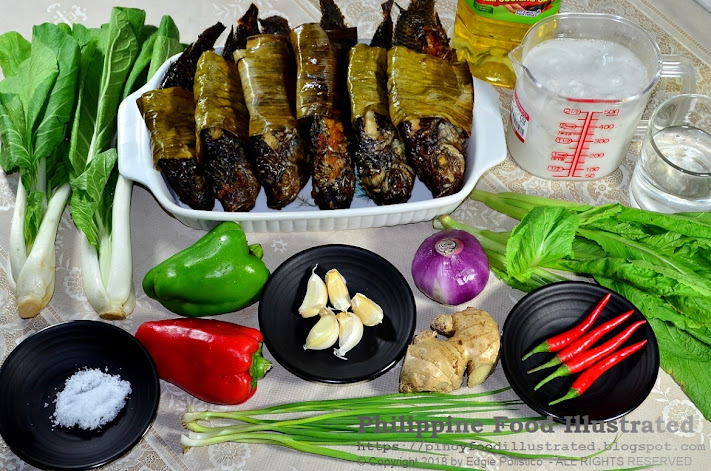
The ingredients

When Visayans migrated to Mindanao at the height of the “Land of Promise” campaign in the 1970s, they brought along with them the traditional Visayan seafood dishes that included linabog. This explains why linabog is also found in Mindanao.

The ingredients are prepared and ready.

In the olden days, the pagi or iho was cooked into inun-onan (boiled in vinegar) without any condiment, as it was merely a process of preserving the catch to last for days without getting rotten. Later on, the inun-onan evolved with condiments introduced to the islands.  The thick coconut cream was used as a desirable ingredient and thought to be a natural protection from possible food poisoning. Hot spice is also added to mask any nasty taste. What used to be thrown away, eventually became a delectable delicacy.

The fish are cooked in vinegar with garlic and salt to taste. Just the way you cook paksiw na isda. Banana leaves are used to wrap each fish to keep the fishes from sticking to each other. The leaves also add aroma to the dish.
When boiled and cooked, excess vinegar is drained.

Now that the Philippine and International Laws on Marine Wildlife Protection prohibits the capture and consumption of the sea fish mentioned above, the tradition of cooking the original linabog shunned away the locals from savoring their old-time favorite linabog. But the taste of linabog lingers making the locals keep on longing for it. When pagi and iho are not available, they resort to hito or haluan. Later on, tilapia is also used.

Cooking oil is added and brought to boil. The fish are fried well until crisp with those bones and fins on the edges would easily brittle.

Excess oil is drained right away after frying, or the fishes are removed from the oil.

Braising the fish first in vinegar with salt and spices transforms “nasty” to “tasty.” It removes the nasty fishy odor of the fish. Cooking is exactly the same way as you cook paksiw na isda. In my recipe, I made the twist of frying the fish after braising them in vinegar with condiments to attain the crispiness of the skin and edges of the fish, which is a favorite of mine when it comes to tilapia. Chewing the crisp-fried bones is nice and tasty. It also eliminates the hassle of picking those tiny bones around the edges, which I often feared might prick my throat if I accidentally swallowed them.

All the spices are sauteed until they caramelize then added with some water, simmered for awhile, then coconut cream is added (below).

Visayans are known to be fond of using creamy coconut milk in their seafood delicacies. Almost all Visayan seafood cooked with coconut cream or coconut milk are my favorites, among them are the tinunoang kinilaw (fish ceviche in coconut cream), the tinunoang kinhason (shellfish in coconut milk), and linabog.

Curry powder

Hot chili pepper

Salt

Sibuyas dahon (chive)

I was inspired by the sinugno of Quezon province that I added pechay leaves (in place of mustasa) in my recipe. Chilies are not strange to Visayans. They use it to spice in many of their dishes. They even have a dish called halang-halang for that. They also squeeze chilies in kinilaw.

Bell pepper (green and red)

Pechay leaves buried in thick coconut sauce, simmered, then transferred onto deep serving dish.

Here’s my version of linabog and enjoy cooking and dining with my fellow Visayan’s comfort food. This will make linabog continue to live on - in a new form

The crisp fried tilapias are arranged on top the savory spicy coconut sauce. To eat, flake the fish, dip or combine it in the sauce, and savor every bite.


See Index of Entries here.


If you liked this post, share it.

Let us know your opinion on the subject. Feel free to comment in the comment section, below. We need to know what you think.

Tell us what other topics you want us to write, share, and discuss.


Related posts:

How to cook Linabog Nga Tilapia
A fully illustrated recipe by Edgie Polistico


All photos by Edgie Polistico posted in this blog are copyrighted. ALL RIGHTS RESERVED.


Continue to follow my blogs. You can also follow and learn more by joining us in our Facebook group. Have more bits and pieces about our kind of food, ingredients, and ways of cooking, dining, and knowing food culture across the 7,641 islands of the Philippines. I will search for more and continue to share my findings. It is my pleasure to rediscover the known and least known things or the unheard ones and put them here for everyone to find, learn, and treasure. 

Encouragement and enthusiasm are not enough. I also need moral support, prayers, and anything else that can uplift my spirit and keep my good reasons. Keep them coming. All I know is that I am happy with what I am sharing and giving away. If you are pleased and happy with what I am doing, just smile and please share the happiness. Keep sharing and include to share the PHILIPPINE FOOD ILLUSTRATED. I feel energized when my blog becomes one of the reasons why you are happy and smiling. 

Edgie Polistico  


For more about Filipino food, see  this Philippine Food, Cooking, and Dining Dictionary. It is OPEN and FREE.


June 17, 2018

miracle fruit

A miracle fruit tree on the roadside of Brgy. Mambago, Sta. Rosa, Babak, Island Garden City of Samal (IGACOS) in Samal island, Davao del sur.


miracle fruit - (Mindanao fruit) [n.] calabash (sc.name: Crescentia cujete).


Miracle  fruit (Calabash) is used to be known only in Mindanao. It was seen growing anywhere there (in red). Latest distribution inventory shows miracle fruit is now all over the Philippines. I marked the provinces and islands in orange labels where miracle fruit is now grown and distributed by locals.

Miracle fruit (internationally known as the calabash) is a tree that bears huge fruits that looks like a buko (young coconut). It grows abundantly everywhere in Mindanao, some parts of the Bicol region, and in the Visayas. Few are also growing in Luzon up to the northern part of Ilocos and Cagayan region (see the food map, above, for the latest inventory). 

At first glance, you could have mistaken this as a young coconut fruit growing on a small tree.

Sadly, most of the fallen fruits were left to rot on the ground. Most local folks do not know what to do to make good use of this wonderful fruit. They dreaded the black color of its flesh and the gummy smell. What they do not realize is that black juice is sweet and has healing wonders, the reason why old folks called it the "miracle fruit."

I tried one. And yes, it was wonderful.


The  outer shell is very hard that you have to cut it with a saw to split open into halves You cannot just cut the calabash fruit with a knife, unless you use a big bolo or machete.   

Many who tried this drink claimed they experienced rejuvenating vigor and mental alertness. It is good when you are going to study, review, or take an exam.  

Local women who have tried the freshly extracted black juice claimed it helped ease their menstrual pain. 

Drinking miracle fruit juice is relaxing and helps you go to sleep, relieve stress, and feel well-rested as you wake up. It makes the skin glow healthy, and feel younger again.

Good for those who are recuperating from sickness and a treat after a weary activity. 


The flesh is white, moist, and soft.
 
I experimented with the first calabash fruit I got from Mindanao. I extracted the juice and processed my first miracle fruit wine at home. I hand-carried one fresh green fruit of calabash on my flight from Misamis Oriental to Metro Manila. I cut open and processed the fruit juice into miracle fruit wine using the needed ingredients that were found in the groceries. After three months of fermentation, I had the wine and enjoyed it.

I wonder if this fruit once grew in the fountain of youth. The vigor made me feel younger. Next time, I will no longer bring a calabash fruit. I will bring the tree.

When boiled, the flesh of calabash turns black.

Here's a calabash fruit I found in Cagayan de oro City, Misamis Oriental in Mindanao. I brought it home in Metro Manila. Cooked it into tea and later processed into wine.
How to know if the miracle fruit is already ripe to harvest:
  • The color of the fruit is dark green and has slight shades and spots of brown.
  • The surface or outer skin is no longer shiny.
  • It is heavier and sounds dull when you knock it with your fingers.         


Personal Notes

Miracle fruit (Calabash) is used to be known only in Mindanao. It was seen growing anywhere there (shaded red in the food map, above). The latest distribution inventory shows miracle fruit is now all over the Philippines. I marked the provinces and islands in orange labels where miracle fruit is now grown and distributed by locals.

I first saw this fruit and the tree on the campus of Notre Dame University, Cotabato City on November 10, 2010. Since then, I took notes on where else I found miracle fruit in Mindanao.

In 2017, I picked a fruit from a tree in Cagayan de Oro and hand-carried it on my flight back to Manila where I tried to process it into wine. The wine turned out good - it tastes jammy and fruity. I kept a bottle of it until now for aging.

Related readings:

Know more about calabash here 


If you liked this post and our site, share it.

Let us know your opinion on the subject. Feel free to comment in the comment section, below. It is important for us to know what you think.

Tell us what other topics you would like us to write, share, and discuss.


Related posts:


Continue to follow my blogs. You can also follow and learn more by joining us in our Facebook group. Have more bits and pieces about our kind of food, ingredients, and ways of cooking, dining, and knowing food culture across the 7,641 islands of the Philippines.

Thank you for all the encouragement and enthusiasm. I need your moral support, prayers, and what else that can uplift my spirit and keep my good reasons. Keep them coming. 

Sharing is happiness to me.  If you are pleased and happy of what you found here, please share the happiness we have in the PHILIPPINE FOOD ILLUSTRATED. I feel energized when it becomes part of the reasons why you are happy and smiling. 

Edgie Polistico


For more abou


t Filipino food, see  this Philippine Food, Cooking, and Dining Dictionary. It is OPEN and FREE.


April 10, 2018

pipinong gubat


pipinong gubat - /pi-pi-nong gu-batTagalog fruit; dw Span. pepino [cucumber] > Tag. pipino  + gubat [forest] [n.creeping cucumber (sc.name: Melothria pendula, Linn.) \wild cucumber.

Other local common names:

  • pipinong ihalas in Cebuano and Boholano

  • a.k.a. pipinong ligaw in  Tagalog   


A variety of very tiny cucumbers having a smooth and watermelon-like berry.

Pipinong gubat or pipinong ligaw of Malolos, Bulacan.

Pipinong gubat or pipinong ligaw of Malolos, Bulacan.

Pipinong gubat found in Tagaytay City, Cavite.

The plant is a perennial climbing vine and can be found growing uncultivated or wild all over the Philippine archipelago, and in other countries on the other side of the world.

pipinong ihalas found on the roadside of Bonifacio, Misamis Occidental. It is strikingly similar in size, shape, color, and taste (yes, I tried it) to that of pipinong gubat in Malolos, Bulacan and in Silang, Cavite.

Pipinong ihalas found in Bonifacio, Misamis Occidental

Pipinong ihalas of Bonifacio, Misamis Occidental


The vine bears tiny oblong-elliptic yellow-green berries which turn black when matured and ripe that grow 10 to 20 millimeters long, and about 12 to 15 millimeters in diameter. 

The crisp young green berries are edible and can be pickled or put fresh and whole in salads. The black ones can be used as purgative for livestock.

Pipinong ihalas from the backyard of our house in Inopacan, Leyte.
Pipinong ihalas of Inopacan, Leyte.
Trying some pipinong ihalas at home in Inopacan, Leyte.
Pipinong ihalas of Inopacan, Leyte.


Personal notes:

Our rural folks still wonder what to do with these tiny cukes. They do not eat them. They thought it is not safe to eat. They regarded the vine as a pesky plant on the farm. They do not know this plant is edible. Few recalled that their old folks used to pick this along the trail and have it as a snack. My dear friend, Jose Benigno Salvador, a Bulaqueño food historian, shared that the Katipuneros of Bulacan used to forage this wild tiny cucumber while trekking the terrains of Bulacan.

The pipinong ihalas I found in Bonifacio, Misamis Occidental is strikingly similar in size, shape, color, and taste (yes, I tried it) to that of pipinong gubat or pipinong ligaw of Malolos, Bulacan and in Silang, Cavite. Last summer, I found it growing in the backyard of our house in Inopacan, Leyte. I learned later in my research that this plant grows all over the archipelago. The fact is, we can actually find this tiny cucumber on the other side of the world, where it is pickled or put in a green salad. Last June 12, 2017, this was served as an heirloom salad by the Siglo Modern Filipino at the View Park Hotel of Tagaytay City, Cavite.


There was a study that found out that the “chemical-bromatologic” analysis of this wild cucumber constitutes a source of water, vitamins, minerals, and even some proteins. The fruits of this plant, despite their reduced size, have a pleasant flavor and are edible for humans. Its foliage is given to livestock as forage. Thus, this “wild cucumber” could be an additional nutritional alternative for men and animals. The wild cuke is 12.6% protein, 16.30% fiber, and 56.8% carbohydrates. The entire plant is good for ruminants.

In Myanmar, the green leaves are eaten as vegetables. One of my friends who learned about this suggested that the leaves can be stir-fried or sautéed with garlic just like when you cook talbos ng kamote (sweet potato tops) or added in soupy dishes as you do with spinachYou may add sahog (meat ingredient) and seasonings of your choice.

When matured or ripe, the fruit would turn black and can be used as purgative, usually to livestock and other foraging farm animals, and even to humans.

Propagation of pipinong gubat is by seed and cuttings.


All photos by Edgie Polistico are copyrighted. ALL RIGHTS RESERVED.


If you liked this post, share it.

Let us know your opinion on the subject. Feel free to comment in the comment section, below. It is important for us to know what you think.

Tell us what other topics you would like us to write, share, and discuss.


For more about Filipino food, see  this Philippine Food, Cooking, and Dining Dictionary. It is OPEN and FREE.


Continue to follow my blogs. You can also follow and learn more by joining us in our Facebook group. Have more bits and pieces about our kind of food, ingredients, and ways of cooking, dining, and knowing food culture across the 7,641 islands of the Philippines.

Thank you for all the encouragement and enthusiasm. I need your moral support, prayers, and anything else that can uplift my spirit and keep my good reasons. Keep them coming. 

Sharing is happiness to me.  If you are pleased and happy with what you found here, please share the happiness we have in the PHILIPPINE FOOD ILLUSTRATED. I feel energized when it becomes part of the reasons why you are happy and smiling. 

Edgie Polistico

HELP ME. I NEED YOUR SUPPORT TO KEEP THIS BLOG GOING


Your contribution will help fund Edgie Polistico's research and development of Pinoy dictionaries.

CLICK HERE on how else to help this project

Help Me

Help Me
This will help Edgie Polistico continue his research and post more in this blog. Your contribution will help fund Edgie Polistico's research and development of Pinoy dictionaries. More discoveries, information, and knowledge will be shared to you and to others because of your generosity. Thank you for giving.

EDGIE'S FORBIDDEN PAGES

USE THIS FREE food dictionary now:

MAIN PAGE

MY COOKING and RECIPES